
AI
When the AI boom kicked off a few years ago we were quite negative, because the technology just didn’t match the hype. The LLMs lied, hallucinated, exaggerated, and that, in our view, rendered them unworkable for large scale adoption. “You were right to push back, that mushroom was poisonous” type thing.
But now it is a few years later and the LLMs improved. Whilst not completely gone (just yesterday I was trying to use Muse by Meta to buy books from Amazon, and it confidently asserted that person ABC had recommended book XYZ, which turned out to be wrong) they are much better. And, for coding, they remain excellent, because code either works or it doesn’t, there’s far less judgement or qualitative considerations for “did the code run”.
However, our view remains that AI is likely to be in a bubble, simply on a mix of valuation and monetisation grounds. You’ve heard us talk often about cheap and cheerful models coming out (often from China, but Muse by Meta is a good US example so I’m updating my talking points) that are open weight and can be run locally. The mix of words (open weight, run locally) are super important, even if they are a bit hard to internalise.
If models are “given away” for cheap, ROIC > WACC is hard to acheive. If models don’t require data centers, ROIC > WACC is hard to achieve.
That brings us to the next issue. Put the above two things aside, and just assume that all actually goes largely to plan. What do revenues need to look like? How likely is it that revenues could achieve these targets?
The first thing is to proportionalise as a percentage of GDP. None of the work below is ours, but it is done by people we regard highly, and comes to us via Hanno Lustig. The AI boom is bigger than anything we’ve seen before. Recall that all of the below ended in tears for the original investors and financiers.
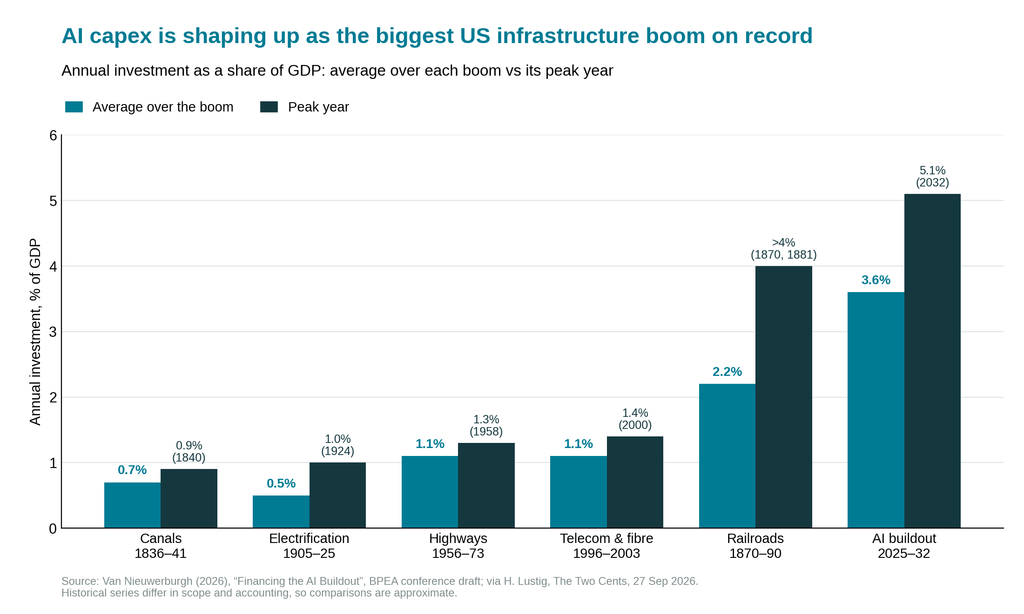
The second thing is to make some assumptions about cost. The process here works mostly in reverse order. Take the incremental capex. Assume the 10% return (NPAT) on that capex. Gross up for tax. Replace the assumed depreciation charge. Gross up again for the opex costs. That’s how you land on revenue. Compare that number to GDP. If you assume a 6-year depreciation schedule, you need AI to be 10% of GDP by 2032, which isn’t that far away.

The next graph is by Jared Bernstein, who undertakes the same analysis, comes to similar conclusions, and takes the view that it simply isn’t likely that the revenues are going to be there.
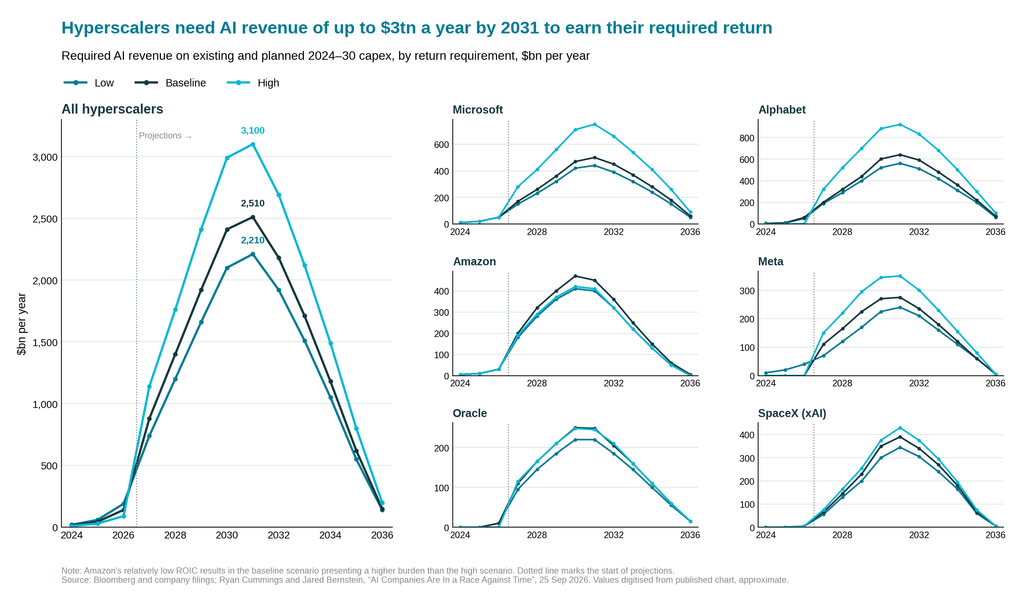
Simply put, we agree. I think it is near impossible to have a recession whilst this arms race takes place. But at some point the build out stops. And the market will front run that, periodically. It will assume some infinite loop of “everyone knows that everyone knows that the boom will end”, and therefore it will turn well before you can actually see anything. It will look fine in the aggregates.
So, we will have to think very carefully about how we play this.
Important Information: This document has been prepared by Aequitas Investment Partners Pty Ltd ABN 92 644 165 266 (“Aequitas”, “our”, “we”), a Corporate Authorised Representative (no. 1284389) of AIP FS Pty Ltd ABN 49 680 982 478 (Australian Financial Services Licensee no. 700016) and is for distribution within Australia to wholesale clients only.
This document is based on information available at the time of publishing, information which we believe is correct and any opinions, conclusions or forecasts are reasonably held or made as at the time of its compilation, but no warranty is made as to its accuracy, reliability or completeness. To the extent permitted by law, neither Aequitas nor any of its affiliates accept liability to any person for loss or damage arising from the use of the information herein.
Past performance is not a reliable indicator of future performance.
General Advice Warning: This document has been prepared without taking into account your objectives, financial situation or needs, and therefore you should consider its appropriateness, having regard to your objectives, financial situation and needs. Before making any decision about whether to acquire a financial product, you should obtain and read the relevant Product Disclosure Statement (PDS) or Investor Directed Portfolio Service Guide (IDPS Guide) and consider talking to a financial adviser.
Taxation warning: Aequitas is not authorised to provide tax (financial) advice and is not a registered tax agent. Investors should seek their own tax advice from a registered tax agent or a registered tax (financial) adviser if they intend to rely on this information to satisfy the liabilities or obligations or claim entitlements that arise, or could arise, under a taxation law. We recommend that you consult a registered tax agent or a tax specialist to confirm your taxation position.

